Mary Keith
Anne of AvonleaMary Keith is a gravely ill mother whose death leaves her six-year-old twins, Davy and Dora, without a home. Though she appears only through other people’s accounts, her efforts to secure the children’s care—and the instructions she gives Davy before she dies—shape their passage into Marilla Cuthbert’s household.
Identity and Circumstances
Mary Keith is a distant relation of Marilla Cuthbert, who describes their connection as a third-cousinship. When Mary is dying, the future of her twins is uncertain. She has a brother in British Columbia and has written to him about the children, but initially has heard nothing back. Marilla, already managing a farm and its responsibilities, worries about what will become of them.
A later letter brings an answer, but not an immediate solution. Mary’s brother is working at a lumber camp and cannot take the children until spring, when he expects to be married and have a home for them. He asks that neighbors keep the twins through the winter. Mary is reluctant to ask: she has not been on good terms with the people of East Grafton and cannot bear to approach them for help.
Illness and Arrangements for the Twins
As Mary grows worse, Marilla understands that the children may need care before their uncle can provide it. Although Mary does not explicitly ask Marilla to take them, Marilla believes from her expression that this is what she wants. The decision weighs on Marilla: the family connection is distant, and caring for two six-year-olds is a serious responsibility. Anne Shirley responds with immediate hope that Marilla will agree, but Marilla says she has not yet made up her mind.
Mary’s brother’s letter leaves a gap of several months between her death and the home he hopes to offer the children. The arrangement that emerges is for Marilla to take Davy and Dora for the winter. Thus, Mary’s circumstances prompt a change in Marilla’s household and give the twins a place to go when their mother can no longer care for them.
Her Final Conversation with Davy
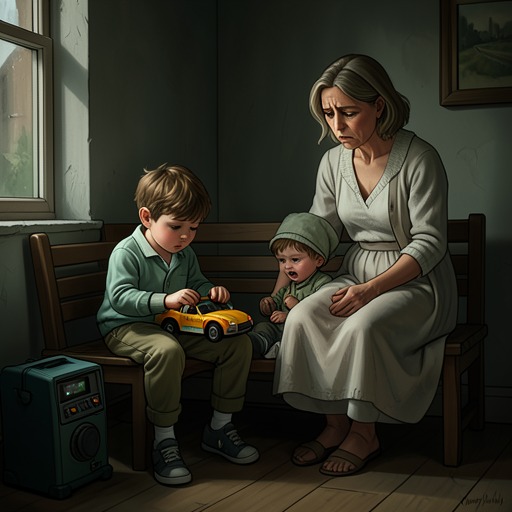
On the day Mary is buried, Davy tells Marilla that he and his mother had talked the night before she died. According to him, Mary said she was glad to die because she was so tired of being sick. She also told him that Marilla would take him and Dora for the winter and charged him to be a good boy.
Mary’s instructions include a specific responsibility toward his sister: he is always to be kind to Dora and stand up for her. Davy’s behavior makes the instruction complicated rather than sentimental. He has just tugged Dora’s curls, but insists that he will not let anyone else pull them. His possessive defense is not yet the kindness Mary asked for; her words establish a standard that Marilla and the others will have to teach him to meet.
Narrative Role
Mary is characterized through the practical and emotional consequences of her absence rather than through scenes of her life. The unanswered letter, the brother’s delayed ability to take the children, and Marilla’s uncertainty make her illness a problem of care as well as loss. Her final message, reported by Davy, carries her parental concern beyond her death: the children’s immediate home is arranged, while Davy is left with a promise about how he should treat Dora.